

Notable Native - John Lyle Campbell
By Jeremy Elliott, JHC Executive Director 2026
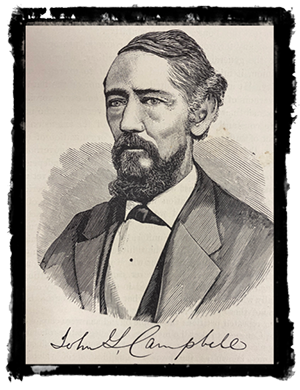 John Lyle CampbellAs we honor the Semiquincentennial of our Declaration of Independence this year and celebrate the birth of this great nation, I would like to reflect on a celebration that occurred 150 years ago and make it all about another of the remarkably impressive human beings Washington County, Indiana has produced.
His name is John Lyle Campbell, who became Professor John L. Campbell of Wabash College and Secretary of the 1876 Centennial Exposition of Philadelphia, celebrating the first 100 years of these United States, which after all was his idea.
He was born in Salem, on the northeast corner of Water and Mulberry Streets, on October 13, 1827. Salem was 13 years old and had a population of approximately 825 people. His father was David Garvin Campbell, who migrated to Salem in 1818 when he was 20 years old from Harrodsburg, Kentucky. He opened the first woolen mill in Salem, in the mid 1820s, and was the chief officer in that industry for nearly 30 years. He would also serve a term as our County Treasurer, from 1832-1834. Professor Campbell’s mother was Rosanna Lynn, who was from a family of 10 children and migrated to Washington County with her parents from Jefferson County, Kentucky, also in 1818. They settled near Livonia, where her father, Samuel Lynn, opened a tan-yard.
David and Rosanna were married in September of 1822 and took up their residence at the aforementioned northeast corner lot at Water and Mulberry Streets. Here the couple had five children between 1823 and 1832. John Lyle Campbell was their third child. He had an older sister, Harriet, who died at the age of nine and a younger brother, Addison, who died in infancy. Sadly, he lost his mother during the cholera epidemic of 1833 and she was buried in the Livonia Cemetery. This left David with three young boys to raise, Robert, who was 8, John, 6 and Samuel Lynn, who was only 3 at the time. In September of 1834, David remarried to Mary Forsey, who would prove to be a loyal companion and stepmother to the three surviving sons.
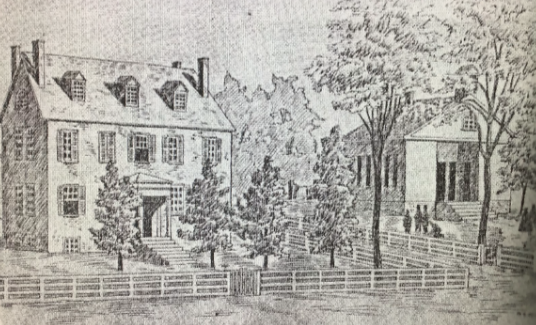 John I. Morrison’s Washington County Seminary, corner of College Ave. & Hackberry StreetJohn L. Campbell was born ten years before public schools were established in Salem, so he likely attended a small private school that were generally conducted for three to four months of the year. However, by the age of twelve he was enrolled in the Washington County Seminary, under the tutelage of the noted schoolmaster, John I. Morrison, from which he graduated in 1843, at sixteen years of age.
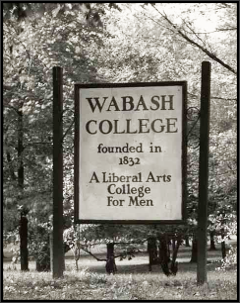 The following year he was enrolled in Wabash College and graduated from that institution, with honors, in 1848. Part of the year, following his graduation, he worked for the newly established New Albany & Salem Railroad as a surveyor determining the line for the rails. By the fall of 1849, he had accepted a position as a tutor for Wabash College. In 1851, after receiving his masters degree, he was elevated to the position of principal of the college’s preparatory department and served in this capacity for two years. During this time he devoted all of his free time to the study of law and passed the state bar in 1853.
The same year that he received his license to practice law, he was appointed associate professor of mathematics for Wabash College, and in June of 1854, he was made professor of mathematics, physics, natural philosophy and astronomy. A position he would retain for another fifty years. Also, in 1854, Professor Campbell married Mary Ellen Johnston, the daughter of Reverend James and Eliza Johnston, of Madison, Indiana, in Crawfordsville. His father-in-law even officiated the ceremony. John and Mary would have three daughters during the course of their marriage, Anna Lynn, who was born in 1856, Jane Rose, born in 1860, and Mary, who was born in 1867. All three of their daughters married very successful attorneys and left behind several surviving children, so undoubtedly Professor Campbell still has direct descendants living in our state today.
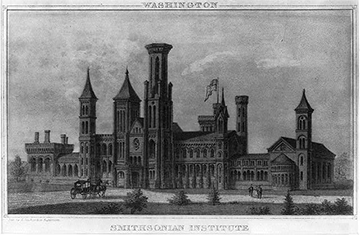 Early rendering of the Smithsonian InstituteIn 1864, a significant event occurred in Professor Campbell’s life that he later claimed was the inspiration for his most noteworthy idea. He was personally invited, by Professor Joseph Henry, the first Secretary of the Smithsonian Institution, to deliver the address over the life and teachings of Galileo at their facility in Washington DC. The presentation was well received and highly spoken of, and was the occasion that Professor Campbell said sparked the idea of holding the centennial celebration of 1876 in Philadelphia.
Two years after this event, President Ulysses S. Grant appointed Professor Campbell to the Board of Visitors to West Point. Later that year, John wrote letters to the Mayor of Philadelphia, Morton McMichael and to US Senator Henry Lane of Indiana, suggesting and giving an outline of a plan for the centennial celebration to be held in Philadelphia. He promptly received hardy endorsements from both men, who promised their full cooperation at the appropriate time. As talk of John’s proposal began to spread, the Franklin Institute in Philadelphia, became an early supporter and they petitioned the Philadelphia City Council for use of Fairmount Park, which was granted in January of 1870. The Philadelphia City Council and the Pennsylvania General Assembly created a committee to study the project and seek support of the US Congress.
Pennsylvania Representative Daniel J. Morrell introduced a bill to create a United States Centennial Commission and it passed on March 3, 1871. With the strong recommendation of Indiana Governor Conrad Baker, Professor Campbell was appointed to the commission by President Grant on April 29, 1871. The majority of the rest of the commission was organized the following year and included one representative from each state and territory. At their first meeting on March 4, 1872, John Campbell was honored with the position of chairman of the committee on permanent organization and was also placed as the head of the committee on foreign affairs.
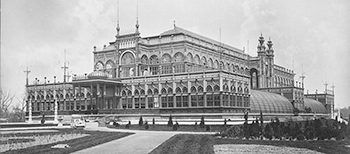 Main Exhibition Building 1876 Centennial ExpositionThe commission classified the exhibits into seven departments: agriculture, art, education and science, horticulture, machinery, manufacturers, and mining and metallurgy. A commission was sent to Europe to invite nations to participate in the exposition and despite fears of a European boycott, no country declined an invitation. Temporary hotels, boarding houses, police stations and a hospital were constructed near the exposition’s grounds to accommodate the expected staff and visitors. Herman Schwarzmann, an engineer for Fairmount Park, was appointed as the chief architect for the Centennial Exposition and he designed Memorial Hall, Horticultural Hall and several of the other smaller buildings on the grounds, including the landscaping around them. In total, more than 200 buildings were constructed, which were surrounded by a fence over three miles long. The Main Exhibition Building, which was a temporary structure, enclosed twenty-one and a half acres under its roof and was the largest building in the history of the world at that time. It took 18 months to build and cost over 1.5 million dollars.
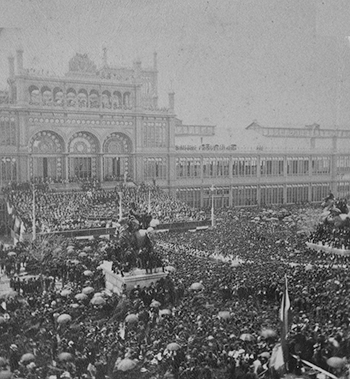 Opening ceremonies for the Centennial Exposition, May 10, 1876The exposition originally scheduled to open in April of 1876, to commemorate the anniversaries of the Battles of Lexington and Concord, but construction delays pushed the opening ceremonies back to May 10. On that date, bells rang all over Philadelphia to signify the opening of the exposition, which was attended by President Grant and his wife, as well as Emperor Pedro II of Brazil. The official attendance for the first day was placed at 186,272 people. The fair, which became the first world’s fair hosted by America, received contributions from thirty-eight other countries. The highest date of attendance was September 28, which was Pennsylvania Day, when they celebrated the 100th anniversary of the Pennsylvania Constitution and nearly 250,000 people came for the festivities. By the time the exposition ended on November 10, 1876, over 10 million people had visited.
Some of the consumer products that debuted at the exposition included: Alexander Graham Bell’s telephone, the typewriter, Heinz Ketchup, Hires Root Beer and the most popular introduction was popcorn. Exhibits included: the right arm and torch of the Statue of Liberty (for 50 cents visitors could climb to the balcony around the torch and this is how they funded the pedestal for the statue), the 1400 horsepower Corliss Steam Engine, and the Beaver Falls Cutlery Company displayed the world’s largest knife and fork, both over six feet in length. Colonial era relics displayed included: General George Washington’s uniform and tent from the Revolutionary War, a silver teapot from Marquis de Lafayette, a sword worn by Captain Nathan Barrett during the Battle of Concord, and the legend of Betsy Ross sewing the first United States flag was widely circulated at this event through her grandson and immediately embraced by attendees.
The Centennial Exposition impressed foreigners with the industrial and commercial growth of our country, the level of exports increased and imports decreased, and the trade balance grew in favor of the United States. It is also credited for raising America’s appreciation for its past, boosting enthusiasm for collecting and preserving historical items, and it is argued that the fair launched the colonial revival movement. Soon after the centennial exposition, several exclusive societies were formed including, the Sons of the American Revolution, the Daughters of the American Revolution and the Colonial Dames. The exposition is frequently referred to as America’s coming-of-age party and it signaled our rise from an agrarian nation to a global industrial competitor.
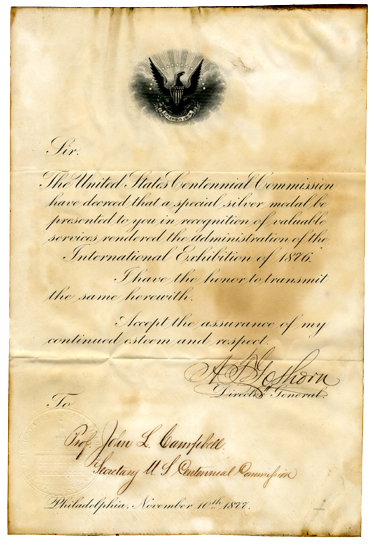 After the smashing success of the Centennial Exposition, Professor John Campbell, for his service to the Centennial Commission and the nation, was reportedly awarded a gold medal, a certificate and an ivory handled cane crafted from the wood of Independence Hall. (The latter two are among the archives at Wabash College.) As you can see from the certificate, it claims he was awarded a silver medal, but every article I have come across reports he was awarded a gold one. During 1876, he was also awarded with an LL.D. from Indiana University.
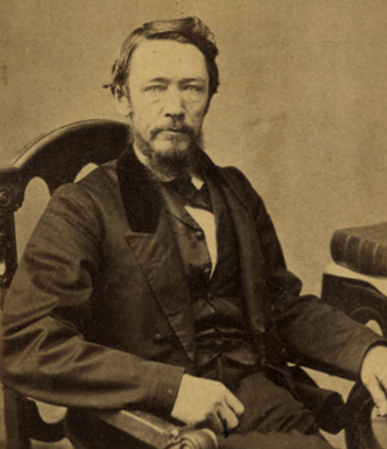 Professor John Lyle Campbell, circa 1876John returned to Crawfordsville and the college for the fall term of 1877, after spending nearly two years in Philadelphia, with renewed vigor and miraculous cutting-edge technology, including Edison’s electric light. By March of 1880, he had installed the necessary equipment to generate an exhibit of electric light in an area of the campus now called the Arboretum. The Wabash newspaper reported, “As we watched the brilliant white light with its immense illuminating power, we could not help but think of the comparatively recent time when such a thing as the electric light was unknown. Professor Campbell, with the aid of the proper electrical apparatus, can wield with impunity the winged lightning as well as almighty Jupiter, though on a smaller scale.” This event was said to have amazed the population and it occurred 11 years before the city of Crawfordsville entered the electrical age and got its first municipal light plant.
From 1878 to 1886, Professor Campbell was selected to participate and assist with the United States Coast and Geodetic Survey. This survey was actively developing a transcontinental triangulation arc that crossed the country, providing accurate longitudinal and latitudinal points which passed through Indiana. In 1882, he was appointed to the Topographical survey of the Kankakee Valley, by Governor Albert Porter, to drain roughly 600,000 acres of wetlands, known as the “Grand Marsh” or the “Everglades of the North,” into agricultural land. In 1891, he was appointed to the Indiana Commission for the World’s Columbian Exposition that was held in Chicago in 1893, by Governor Alvin P. Hovey.
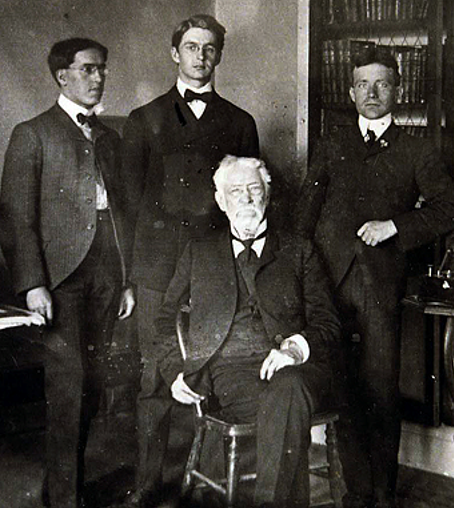 He continued in his professorship at Wabash College until his death, on September 7, 1904. His career at this institution spanned from 1849 to 1904 and to this day he is still the longest serving faculty member of Wabash College. He was interred in the Oak Hill Cemetery, in Crawfordsville. In a recent article produced by Beth Swift, the archivist at Wabash College, the following unattributed quote was included about the professor, Campbell was an amazing man and a great teacher. It was said that he had "enough political ability to have made a great statesman, enough legal acumen to have made a great jurist, enough executive ability to have made a modern captain of industry, enough courage to have made a great soldier…” And yet he chose to use all of his talents and abilities to teach the upcoming generations. He was definitively the epitome of a “Wabash Man” and another stellar example of why Salem, Indiana used to be referred to as the Athens of the West.
